
Mohr Siebeck GmbH & Co. KG
Booth number: A1803
www.mohrsiebeck.com
About us
Mohr Siebeck is an independent, family-owned academic publisher and, since its founding in 1801, one of the most distinguished scholarly publishing houses in the German-speaking world and beyond. Over more than two centuries, we have established ourselves as a leading publisher in German legal scholarship and in the international study of religion — shaping the research landscape in these fields through a carefully curated, rigorous program.
Our catalog encompasses more than 13,000 titles currently in print, spanning Law, Theology, Religious Studies, Economics and Social Sciences, Philosophy, and Classical Studies. Each year, we publish several hundred new titles and new editions — chosen not by volume, but by scholarly merit.
The about 50 members of our team uphold this standard every day. Our editors are subject-matter experts in their own right: they are not merely skilled in the craft of publishing but are deeply immersed in the academic disciplines they serve. This in-house expertise is what enables us to guide authors with genuine intellectual insight — and it is why scholars from around the world choose Mohr Siebeck as their publishing partner.
We publish monographs, commentaries, critical editions, Festschriften, collected volumes, and series — in print and digitally through our own eLibrary at mohrsiebeck.com, which offers global access to our full program since 2018. We are also actively developing Open Access models to make research results available as broadly as possible.
For readers and institutions from the Arabic-speaking world, Mohr Siebeck offers something of particular relevance: a publishing tradition rooted in rigorous peer review, philological precision, and the serious scholarly engagement with religious texts and legal traditions that has long characterized the highest standards of Islamic and Arab academic culture. Our extensive programs in theology, religious history, and legal theory — including foundational works in comparative religion and the history of law — reflect a deep respect for the intellectual heritage that Arabic scholarship has contributed to world knowledge. We are committed to making this dialogue visible.
As an independent, family-owned house — free from corporate constraints and stock market pressures — every publishing decision is guided by a single criterion: the scholarly and intellectual value of the work. Our mission is to be a „lighthouse for excellence": to identify research that matters, and to give it the reach it deserves.

-thumb.webp)


Address
Wilhelmstr. 18
72074 Tuebingen
Germany
E-mail: info@mohrsiebeck.com
Phone: +49 7071 92346
Internet: www.mohrsiebeck.com
Contact person:
Manuela Kerkhoff
Foreign Rights Manager
E-mail: kerkhoff@mohrsiebeck.com
Phone: +49 7071 92346
Hosung Maeng
rMaeng2 - CEO Translation Rights Agency Korea - on site
E-mail: hosung@rmaeng2.com
Phone: +82 10 3116-2917
Products & Services
Mohr Siebeck is an academic publisher with over 13,000 available titles covering Law, Theology, Religious Studies, Economics, Social Sciences, Philosophy and Classical Studies. Please browse in our latest complete catalogue: https://www.mohrsiebeck.com/en/service/catalogs-directories/
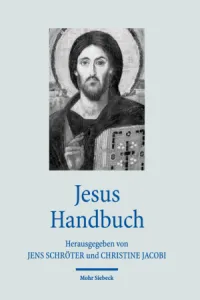
Jesus Handbook
This Guide to Jesus provides an outline of international Jesus research. It presents interpretations of the figure of Jesus in the history of Christianity from its beginnings until the first decades of the twenty-first century. Furthermore, the activity, teaching, and fate of Jesus in its religious, social, and political context are dealt with. Thereby, actual discourses in the hermeneutics of history as well as recent archaeological findings are considered. The last part of the Guide to Jesus is devoted to receptions of Jesus in early Christianity. It therefore provides an overview on the person of Jesus, his activity, and fate as well as receptions of Jesus in the history of Christianity. Because its contributors are all internationally renowned scholars from different countries, the compendium thus provides a representative overview of current Jesus research.
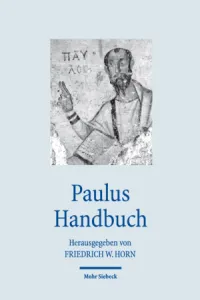
Paulus Handbook
This Guide to Paul focuses on the life, letters and theology of Paul. These main subjects are framed by research history and a description of the impact and the reception of the apostle. More than forty authors depict the path of Paul the Pharisee to Paul the apostle to the Gentiles, analyze his letters and reconstruct the origins of his Christian theology. All those who read the entire Guide will find themselves in a broad research landscape which for some may be new and unfamiliar in that it deals with issues of ancient history, epistolography as well as cultural and social history. Paul's theology, his letters and his language have had a distinctive impact on Christianity. It is the goal of the Guide to Paul to provide students, lecturers and all those interested in a central figure in early Christianity with an introduction to a lively research environment on Paul as a person and on his work.
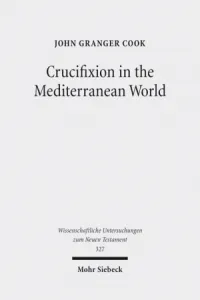
Crucifixion in the Mediterranean World
John Granger Cook traces the use of the penalty by the Romans until its probable abolition by Constantine. Rabbinic and legal sources are not neglected. The material contributes to the understanding of the crucifixion of Jesus and has implications for the theologies of the cross in the New Testament. Images and photographs are included in this volume.
»[Cook] has offered the guild of classicists and New Testament scholars much more: an immensely detailed depiction of crucifixion in the ancient world replete with insightful commentary and illuminating images that will likely become the standard in the field for generations to come.«
Charles L. Quarles in Review of Biblical Literature, http://www.bookreviews.org (04/2015)
»This is a major and substantial work that will be a valuable resource for many years to come. Cook […] provides a thorough and deeply documented study of the practice and meaning of crucifixion as a form of capital punishment in the ancient Mediterranean world.«
Donald Senior in The Bible Today 2014, p. 375-376
»This volume, with its encyclopedic scope, is the most thorough treatment of the subject yet produced. Cook has done a lifetime's work here and he deserves our appreciation for assembling such a complex, thorough, and useful work.«
Jim West on http://zwingliusredivivus.wordpress.com/2014/10/03/crucifixion-in-the-mediterranean-world/
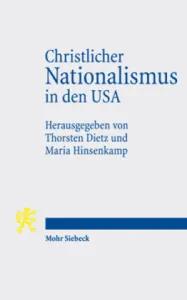
Christian Nationalism in the United States
Christian Nationalism in the United States.
Theological Explorations of the History and Profile of a Globally Influential Movement.
Christian nationalism is primarily a U.S.-American phenomenon that at the same time has a global impact. Internationally, numerous parallel developments can be observed, including those in Germany. Of particular importance is the observation that within highly conservative and fundamentalist groups, theological convictions and narratives have emerged that render Christian communities susceptible to right-wing and far-right political ideologies. The contributors focus on especially influential evangelical and charismatic movements in the United States and demonstrate that there is no uniform ideology of Christian nationalism. Neocalvinist and fundamentalist groups have for some time developed theological convictions that lead them to adopt a critical stance toward liberal and pluralistic society and to aspire to a form of state grounded in Christian principles. In recent years, neo-charismatic networks have additionally gained influence; these pursue authoritarian ideals and openly seek political power. Both their understanding of God and of the human being, as well as certain social-ethical concepts, are shaped by dualistic patterns of thought and by authoritarian ideals. The contributors to this volume examine which theological convictions within specific movements contribute to their endorsement of authoritarian politics, both domestically and internationally. They raise the question of the extent to which these groups and their networks already exert influence within the German-speaking world. This development calls for intensive theological engagement in Germany as well.
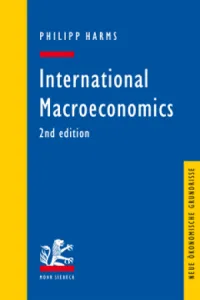
International Macroeconomics
What are the most important concepts and methods of modern international macroeconomics? Philipp Harms presents them in a comprehensive yet accessible way and enables the reader to assess the contributions of various theoretical approaches and results.
Additional material (solutions to exercises, a dictionary) is available here: http://www.international.economics.uni-mainz.de/274_ENG_HTML.php
A slide set for teaching is available from the author on request.
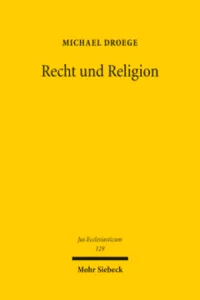
Law and Religion
Law and Religion. Contributions on Religious Constitutional and Canon Law.
In the context of social and religious pluralisation, establishing the relationship between religion, religious actors, and the secular state is challenging. And while religion is not only a potential source of meaning for individuals, it is also of public significance, with still large Christian churches, along with other religious communities and their institutions, continuing to perform important functions in society. However, due to increasing secularisation and a decline in church membership, the traditional rights of religious communities are becoming less widely accepted. The transformation of religious sociological milieus and affiliations necessitates significant adjustments to the law and organisation of shrinking religious communities. This volume brings together contributions from the last two decades that address these developments from the perspective of constitutional law on religion and Protestant church law.
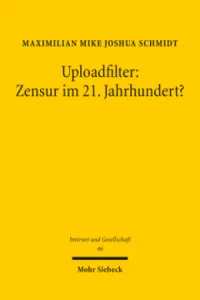
Upload Filters: Twenty-First Century Censorship?
Upload filters promise automated internet regulation, but do they cross a line when it comes to censorship? Maximilian Schmidt's sharp interdisciplinary analysis dissects filter algorithms, constitutional and European Union law to ask: Do they merely regulate or actually control public discourse?
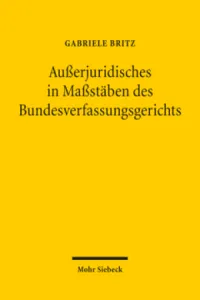
Extra-Legal Elements in the Federal Constitutional Court's Standards
Extra-Legal Elements in the Federal Constitutional Court's Standards. Mechanisms, Legitimacy, and the Empirical Requirements of Fact-Driven Constitutional Development.
Judicial constitutional development by the Federal Constitutional Court has preoccupied constitutional scholarship since the Court began its work in 1951. And yet it is still not fully clarified what precisely occurs in this process, and in what way. The pronounced factual dimension of the Court's standard-setting has so far received little attention. The exemplary analysis of case law shows how strongly extra-legal assumptions shape constitutional interpretation. The Court's work in interpreting the Basic Law incorporates a wide range of assumptions about under which interpretation constitutional norms can in fact achieve the effect intended for them. For this reason, fact-driven constitutional interpretation is modelled as an independent mechanism of constitutional development, distinct both from normatively driven standard-setting and from factual assumptions involved in constructing the case-specific facts. More broadly, the study also aims to determine more precisely the potential tension between judicial constitutional development and political will-formation. Where factual assumptions shape constitutional development, the process is less a matter of normatively creative innovation than of norm-preserving adaptation to the real conditions under which law is realised. This also shifts the potential for tension inherent in judicial constitutional development. Key challenges are the adequate empirical substantiation of standard-forming factual assumptions and the determination of an appropriate balance between expert validation and the Court's everyday theory of the world. From a careful engagement with the empirical dimension of constitutional interpretation in legal scholarship and legal practice, rational constitutional development can thus emerge.